---
title: "EU 2025/1466 and aRMM: Why Pharmacovigilance Needs AI-Native Systems"
description: EU Regulation 2025/1466 doesn't just change what pharmacovigilance must report — it changes how it must operate. This analysis explains why aRMM sits at the center of that shift and what it means for document-centric systems.
image: https://resources.quartica.com/hubfs/aRMM%20main%20image%20for%20blog%201000%20x%20500.jpg
---
[Skip to content](https://resources.quartica.com/insights/eu-2025-1466-armm-ai-native-pharmacovigilance/#main-content)
[ ](https://www.quartica.com/)
- [Why Quartica](https://www.quartica.com/why-quartica/)
- [MARS AI Platform](https://www.quartica.com/products/product-overview/)
- [Resources](https://resources.quartica.com/insights)
- [About](https://www.quartica.com/about/company/)
Open main navigation
Close main navigation
- [Why Quartica](https://www.quartica.com/why-quartica/)
- [MARS AI Platform](https://www.quartica.com/products/product-overview/)
- [Resources](https://resources.quartica.com/insights)
- [About](https://www.quartica.com/about/company/)
- [ Schedule a Call ](https://resources.quartica.com/blog#Schedule_A_15min_Call)
[ Schedule a Call ](https://resources.quartica.com/blog#Schedule_A_15min_Call)
Apr 15, 2026 9:17:02 PM
# EU 2025/1466 and aRMM: Why Pharmacovigilance Needs AI-Native Systems
[ Marianne Zarro ](https://resources.quartica.com/insights/author/marianne-zarro)
Share: [facebook-f icon ](http://www.facebook.com/share.php?u=https://resources.quartica.com/insights/eu-2025-1466-armm-ai-native-pharmacovigilance/) [linkedin-in icon ](http://www.linkedin.com/shareArticle?mini=true&url=https://resources.quartica.com/insights/eu-2025-1466-armm-ai-native-pharmacovigilance/) [envelope icon ](mailto:?body=https://resources.quartica.com/insights/eu-2025-1466-armm-ai-native-pharmacovigilance/)
[](https://resources.quartica.com/insights)
For much of the past decade, pharmacovigilance operations have been organized around documents. Risk Management Plans (RMPs), Periodic Safety Update Reports (PSURs/PBRERs), and post-authorization studies (PASS) have been treated as discrete deliverables, each assembled at defined intervals to meet regulatory expectations. These documents have served as the primary mechanism through which safety is described, assessed, and communicated.
With the introduction of Implementing Regulation (EU) 2025/1466, fully applicable as of February 12, 2026, the European pharmacovigilance landscape is undergoing its most significant shift in over a decade. While the regulation spans multiple domains - signal management, third-party governance, risk-based auditing, PSMF, PSUR/PASS reporting, and literature/ICSR standards, the underlying change is more fundamental:
Pharmacovigilance is moving away from producing documents at reporting milestones toward continuously demonstrating how safety decisions are made, implemented, and validated in practice.
#### Why aRMM is Where 2025/1466 Hits Hardest
The impact of this shift is most visible in the growing regulatory emphasis on additional Risk Minimisation Measures (aRMMs).
aRMMs sit at the intersection of:
- RMP commitments
- Real-world implementation (sites, investigators, patients)
- Distribution logistics and compliance
- Health authority feedback and effectiveness evaluation
Historically, aRMMs have been defined within the RMP and operationalized through a combination of local plans, distribution processes, and effectiveness studies. While structured, these activities have often been loosely connected. Strategy, execution, and evaluation have existed in adjacent but separate layers, requiring significant manual effort to reconcile what was intended with what actually occurred.

Under EU 2025/1466, that separation becomes increasingly difficult to sustain. Regulators now expect that risk minimisation effectiveness is evidenced rather than assumed, that implementation is traceable across regions, sites, and stakeholders, and that outcomes are clearly linked back to benefit–risk evaluation.
The focus shifts from documenting intent to continuously evidencing performance in practice.
This places aRMM at the center of a more dynamic and continuous pharmacovigilance model. It is no longer sufficient to define measures and later assess them; the process must show how actions taken in the field translate into measurable outcomes and how those outcomes influence ongoing safety strategy.
#### The Connected Evidence Loop: RMP, aRMM, and PBRER Are No Longer Separate
What emerges from these expectations is not a set of independent workflows, but a tightly connected process loop.
The RMP establishes the risk minimisation strategy, including the definition of aRMMs. These measures are then operationalized through global and local processes, where distribution, execution, and stakeholder engagement generate evidence on how those measures function in practice. That evidence does not remain within the aRMM domain; it feeds directly into PSUR/PBRER assessments, informing benefit–risk evaluation and the adequacy of existing controls.
In practice, this means that aRMM effectiveness is no longer evaluated in isolation; it becomes a direct input into PSUR/PBRER conclusions, which in turn inform whether existing risk minimisation strategies remain adequate or require modification within the RMP.
The outcomes of these evaluations, in turn, drive updates to the RMP and may trigger modifications to existing measures, the introduction of new interventions, or the initiation of PASS activities where further evidence is required. The process is inherently cyclical, with each stage informing the next in a continuous flow.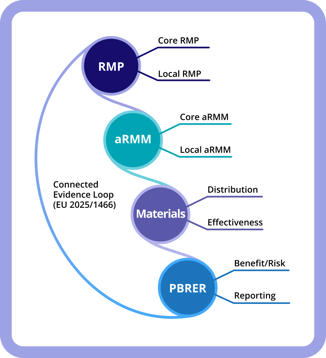
In essence, pharmacovigilance shifts from a sequence of document-driven activities to a connected evidence loop, where strategy, execution, and evaluation are continuously aligned.
What is becoming evident is that maintaining this loop in a consistent and reliable manner cannot depend on manual coordination alone. As the volume of data, decisions, and interdependencies increases, the ability to sustain a connected evidence flow requires systems that are inherently designed to manage relationships across content, processes, and outcomes. This is where the shift toward more AI-native, content-centric approaches begins to emerge —not as a matter of efficiency, but as a structural requirement to support continuous, data-driven pharmacovigilance.
An AI-Native System is a software designed from the ground up with artificial intelligence as its core, foundational component, rather than adding AI as a feature on a traditional software.
#### Discover how this operating model applies to your aRMM and RMP processes with a quick call or full demo from the experts at Quartica.
[ Schedule a Call ](https://calendly.com/alan-fainer-quartica)
#### The Collapse of the Document Boundary
One of the most consequential implications of the regulation is that PSURs, RMPs, PASS outputs, and aRMM evidence can no longer exist as independent artifacts.
Instead, they must reflect a connected evidence chain:
- Safety data → signal detection → evaluation
- Decisions → risk minimization strategies - aRMM
- Implementation → distribution → acknowledgement
- Outcomes → effectiveness → benefit–risk updates
When regulators expect clear demonstration that benefit–risk evaluation is driven by live safety data, and that risk minimisation measures are implemented and effective in practice, the boundaries between documents begin to break down. The RMP, aRMM processes and PSUR/PBRER are no longer independent artifacts; they are different perspectives on the same underlying, continuously evolving evidence system.
Attempting to maintain these relationships purely through documents requires reconstruction of context, reconciliation of data, and interpretation of how decisions were made across time and processes. As the complexity of requirements increases, so does the difficulty of demonstrating a coherent and auditable narrative.
This is where more connected, intelligence-driven models—often enabled by AI-native foundations—become necessary to bridge the gap between how pharmacovigilance operates and how it must now be demonstrated.
#### Traceability Now Spans Roles, Regions, and Partners — Not Just Data
Beyond process integration, the regulation also reinforces expectations around the definition and transparency of the pharmacovigilance system itself.
Marketing Authorization Holders must clearly document roles, responsibilities, and site-specific functions across all activities, including signal management, case handling, RMP preparation, and risk minimisation. This extends the requirement for traceability beyond data and decisions to include accountability and execution.
In practice, this means that organizations must be able to show not only what decisions were made and why, but also who was responsible for each step and how those responsibilities were carried out across different regions and partners. The ability to connect these elements into a consistent and auditable framework becomes critical.
When processes are fragmented, achieving this level of transparency becomes increasingly complex. Each additional handoff or system boundary introduces potential gaps, making it harder to establish a clear and continuous line of sight across the pharmacovigilance lifecycle.
#### The End of Periodic Reporting as the Primary Compliance Mechanism
Taken together, these changes point toward a broader shift in how pharmacovigilance is expected to operate.
The traditional model has been anchored in periodic reporting cycles, where information is gathered, analyzed, and documented at defined intervals. In traditional models, PBRER and RMP processes often operate in silos, with RMP inputs passed to PBRER as static contributions incorporated into specific sections, rather than reflecting a continuously aligned view of data and decisions.
EU 2025/1466 moves the focus toward continuous evaluation, where safety is assessed and demonstrated as part of ongoing operations rather than at specific reporting milestones. In this model, reports such as PSURs or PBRERs do not serve as the primary mechanism for understanding safety. Instead, they become structured representations of a continuously evolving system, reflecting decisions and evidence that already exist within the process.
This reduces the emphasis on assembling information at the time of reporting and increases the importance of maintaining consistent, connected, and traceable processes throughout the lifecycle. Increasingly, this points toward operating models supported by AI-native systems that can manage content as a connected, living structure rather than as isolated documents assembled at intervals.
#### A Structural Shift, Not Just a Regulatory Update
What is unfolding is not simply an incremental regulatory change, but a structural shift in expectations.
The increasing focus on aRMM effectiveness, cross-process traceability, and continuous benefit–risk evaluation highlights a growing misalignment between regulatory requirements and document-centric operating models. As these expectations continue to evolve, that misalignment is likely to become more pronounced.
The implication is not that documents will disappear, but that their role will change. They will continue to be essential for communication and submission, but they can no longer function as the primary system through which pharmacovigilance is managed.
Instead, the emphasis moves toward the integrity of the processes that generate those documents and the ability to demonstrate, at any point in time, how data, decisions, and actions are connected.
#### Closing Thought
For years, inefficiencies in pharmacovigilance have been framed primarily as operational challenges. EU 2025/1466 reframes them as structural ones.
When safety must be demonstrated continuously, when effectiveness must be evidenced in practice, and when traceability must span processes, roles, and geographies, the limitations of siloed, document-driven approaches become increasingly apparent.
aRMM brings this reality into sharp focus. Positioned at the intersection of strategy, execution, and evaluation, it reveals both the complexity of modern pharmacovigilance and the need for a more connected way of operating.
Meeting these expectations consistently and at scale will increasingly depend on systems that can manage pharmacovigilance as a connected whole. This is where AI-native, content-centric approaches begin to play a critical role, not as an overlay to existing processes, but as an enabler of the operating model itself.
Compliance is no longer about producing documents at periodic intervals. It is about ensuring that the system behind those documents is continuously aligned, observable, and defensible across data, decisions, and execution.
### Quartica MARS is built around this operating model. Learn how it applies to your aRMM and RMP processes.
[ About the Solution ](https://www.quartica.com/solutions/rmp-armm-commitment-tracking-software/)
[Featured](https://resources.quartica.com/insights/tag/featured), [RMP aRMM PBRER traceability](https://resources.quartica.com/insights/tag/rmp-armm-pbrer-traceability), [EU pharmacovigilance regulation 2026 key changes](https://resources.quartica.com/insights/tag/eu-pharmacovigilance-regulation-2026-key-changes), [pharmacovigilance compliance 2026](https://resources.quartica.com/insights/tag/pharmacovigilance-compliance-2026), [aRMM effectiveness reporting PBRER requirement](https://resources.quartica.com/insights/tag/armm-effectiveness-reporting-pbrer-requirement), [EU 2025/1466 risk minimisation measures](https://resources.quartica.com/insights/tag/eu-2025-1466-risk-minimisation-measures), [how to evidence aRMM effectiveness regulators](https://resources.quartica.com/insights/tag/how-to-evidence-armm-effectiveness-regulators), [EU 2025/1466 aRMM requirements explained](https://resources.quartica.com/insights/tag/eu-2025-1466-armm-requirements-explained)
## What do you think?
## Related posts
[ ](https://resources.quartica.com/insights/trusted-ai-in-life-sciences-domain-trained-closed-loop-and-governed)
[AI Document Platform](https://resources.quartica.com/insights/tag/ai-document-platform), [AI for Medical Writing](https://resources.quartica.com/insights/tag/ai-for-medical-writing), [Featured](https://resources.quartica.com/insights/tag/featured), [EU pharmacovigilance regulation 2026 key changes](https://resources.quartica.com/insights/tag/eu-pharmacovigilance-regulation-2026-key-changes), [pharmacovigilance compliance 2026](https://resources.quartica.com/insights/tag/pharmacovigilance-compliance-2026), [medical writing software](https://resources.quartica.com/insights/tag/medical-writing-software), [Trusted AI](https://resources.quartica.com/insights/tag/trusted-ai)
## [Trusted AI in Life Sciences: Domain-Trained, Closed-Loop and Governed](https://resources.quartica.com/insights/trusted-ai-in-life-sciences-domain-trained-closed-loop-and-governed)
[Victor Hamel](https://resources.quartica.com/insights/author/victor-hamel)
Consumer AI has gone mainstream, yet life science organizations still struggle to turn it into...
[ Read more ](https://resources.quartica.com/insights/trusted-ai-in-life-sciences-domain-trained-closed-loop-and-governed)
[ ](https://resources.quartica.com/insights/the-ai-roi-paradox-where-efficiency-actually-unlocks)
[AI Operating Model in Pharma](https://resources.quartica.com/insights/tag/ai-operating-model-in-pharma), [AI ROI in Pharma](https://resources.quartica.com/insights/tag/ai-roi-in-pharma), [AI Transformation in Life Sciences](https://resources.quartica.com/insights/tag/ai-transformation-in-life-sciences), [Scaling AI in Pharma](https://resources.quartica.com/insights/tag/scaling-ai-in-pharma)
## [The AI ROI Paradox | Where Efficiency Actually Unlocks](https://resources.quartica.com/insights/the-ai-roi-paradox-where-efficiency-actually-unlocks)
[Ikram Baig](https://resources.quartica.com/insights/author/ikram-baig)
Biopharma is still scaling R&D the same way it always has: by adding people. As clinical portfolios...
[ Read more ](https://resources.quartica.com/insights/the-ai-roi-paradox-where-efficiency-actually-unlocks)
[ ](https://resources.quartica.com/insights/designing-risk-based-compliance-for-ai-from-validation-to-defensibility-1)
[AI Compliance in Pharma](https://resources.quartica.com/insights/tag/ai-compliance-in-pharma), [AI Validation in Life Sciences](https://resources.quartica.com/insights/tag/ai-validation-in-life-sciences), [AI Governance in Regulated Systems](https://resources.quartica.com/insights/tag/ai-governance-in-regulated-systems), [Human-in-the-Loop AI](https://resources.quartica.com/insights/tag/human-in-the-loop-ai), [Featured](https://resources.quartica.com/insights/tag/featured)
## [Designing Risk-Based Compliance for AI: From Validation to Defensibility](https://resources.quartica.com/insights/designing-risk-based-compliance-for-ai-from-validation-to-defensibility-1)
[Ikram Baig](https://resources.quartica.com/insights/author/ikram-baig)
Artificial intelligence has entered regulated life sciences at a moment when regulation,...
[ Read more ](https://resources.quartica.com/insights/designing-risk-based-compliance-for-ai-from-validation-to-defensibility-1)
[](https://www.quartica.com/)
Quartica MARS is a cloud based AI Medical Writing solution which automates generation and workflow of global regulatory compliant documents.
- ###### USA
- ###### Philippines
- ###### India
##### Why Quartica
[Why Quartica
](https://quartica.com/why-quartica/)
[Case Studies
](https://quartica.com/case-studies/)
[Customer Experience
](https://quartica.com/customer-experiences/)
##### Services
[Business Process Consulting
](https://www.quartica.com/services/business-process-consulting/)
[Technology & Support Services
](https://www.quartica.com/services/technology-support-services/)
[Validation Services
](https://www.quartica.com/services/validation-services/)
##### Products
[MARS AI Platform
](https://www.quartica.com/products/product-overview/)
[AI for Life Sciences
](https://quartica.com/products/automation-for-life-sciences/)
[Platform Capabilities
](https://www.quartica.com/products/platform-capabilities/%20)
[MARS Cloud
](https://www.quartica.com/products/mars-cloud/)
##### Solutions
[Pharmacovigilance/Safety Suite
](https://www.quartica.com/solutions/drug-safety/)
[Clinical & Medical Affairs Suite
](https://www.quartica.com/solutions/clinical-medical-affairs/%20)
[Regulatory Affairs Suite
](https://www.quartica.com/solutions/regulatory-affairs/)
[Manufacturing and Quality Suite
](https://www.quartica.com/solutions/manufacturing-quality/)
##### About us
[About Us](https://www.quartica.com/about/company/)
[Resources and Insights](https://resources.quartica.com/insights)
[Leadership
](https://www.quartica.com/about/leadership/)
[Careers
](https://www.quartica.com/about/careers/)
[linkedin-in icon ](https://www.linkedin.com/company/quarticainc/)
---
Quartica MARS - AI Medical Writing cloud based platform for the life Sciences
Copyright © 2026 Quartica, Inc.
```json
{
"@context" : "https://schema.org",
"@type" : "BlogPosting",
"author" : {
"@type" : "Person",
"name" : "Marianne Zarro",
"url" : "https://resources.quartica.com/insights/author/marianne-zarro"
},
"dateModified" : "2026-05-27T17:19:12.504Z",
"datePublished" : "2026-04-16T01:17:02.000Z",
"headline" : "EU 2025/1466 and aRMM: Why Pharmacovigilance Needs AI-Native Systems",
"image" : [ "https://resources.quartica.com/hubfs/aRMM%20main%20image%20for%20blog%201000%20x%20500.jpg" ],
"mainEntityOfPage" : {
"@id" : "https://resources.quartica.com/insights/eu-2025-1466-armm-ai-native-pharmacovigilance/",
"@type" : "WebPage"
},
"publisher" : {
"@type" : "Organization",
"logo" : {
"@type" : "ImageObject",
"url" : "https://resources.quartica.com/hubfs/quartica-new-logo.png"
},
"name" : "Quartica"
}
}
```